 Diving Deeper
Seven Big Banks Reported $5.5 Billion in BlackRock's Bitcoin ETF
Wells Fargo's IBIT shares doubled to 49.6 million. A 13F can't say whose money it is, and bitcoin has fallen about 22% since Sept. 30.

Seven of the biggest banks that file with the SEC reported a combined $5.49 billion of BlackRock's iShares Bitcoin Trust (IBIT) on Sept. 30, their quarterly 13F filings show. Wells Fargo alone listed $2.35 billion in a filing made Monday, the last day for third-quarter reports.
Those numbers are seven weeks old. Bitcoin traded at $65,034 at 8:12 a.m. ET Tuesday, per CoinGecko, about 22% below its Sept. 30 level near $83,600. A Coindaro review of the filings puts the drop at 22% too.
The bank-by-bank count
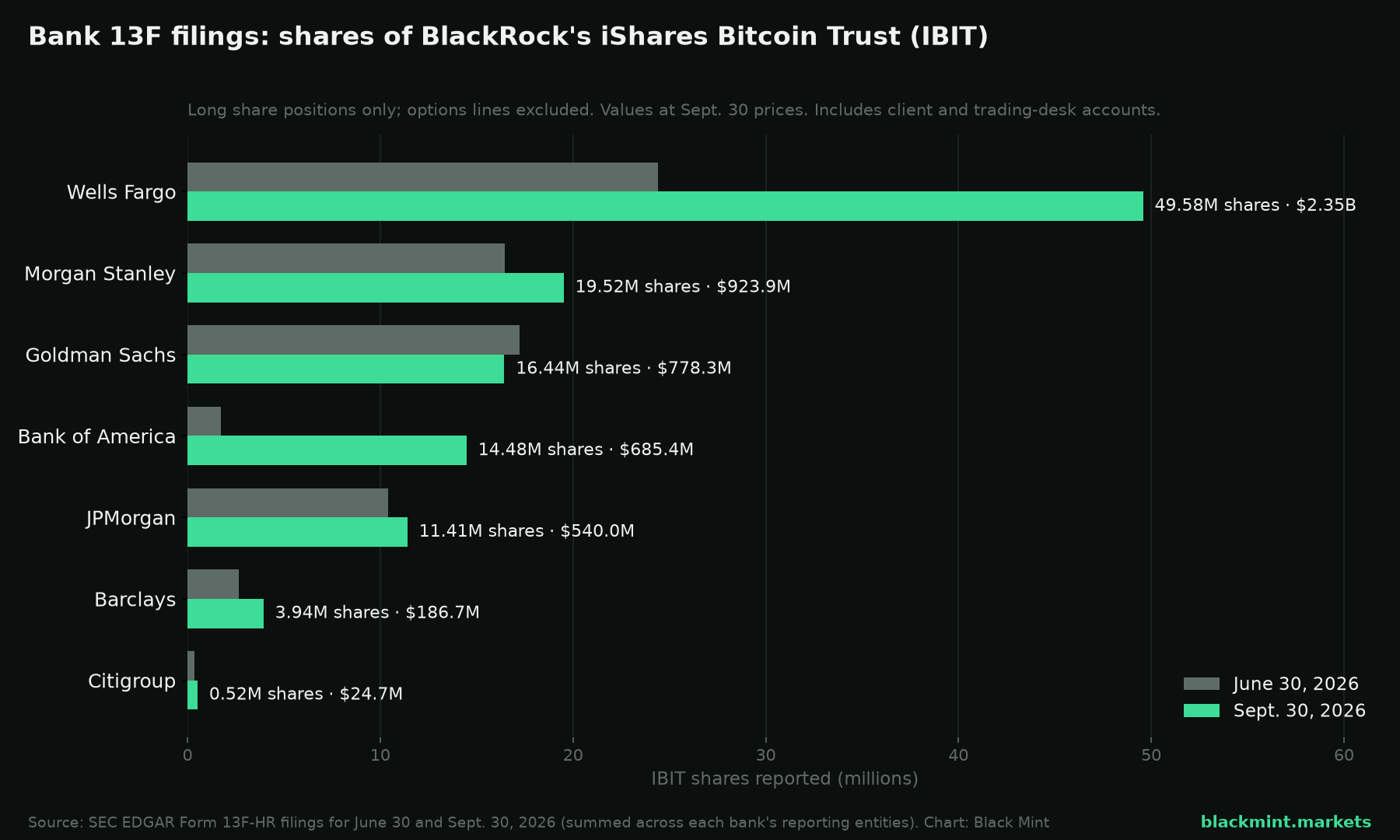
IBIT shares reported on Sept. 30, against June 30, from each bank's 13F and Coindaro's tally of the same filings:
- Wells Fargo: 49.58 million shares worth $2.35 billion, up from 24.40 million
- Morgan Stanley: 19.52 million, $923.9 million, up from 16.48 million
- Goldman Sachs: 16.44 million, $778.3 million, down from 17.23 million
- Bank of America: 14.48 million, $685.4 million, up from 1.72 million
- JPMorgan: 11.41 million, $540.0 million, up from 10.41 million
- Barclays: 3.94 million, $186.7 million, up from 2.66 million
- Citigroup: 521,144 shares, $24.7 million, up from 347,114
Bitcoin rose about 42% over the quarter, so dollar values grew faster than share counts. Share counts are the cleaner gauge of buying. Goldman's count fell 4.6% while the value of its line rose 36%. JPMorgan's 9.6% rise and its $540 million figure match The Block's report.
IBIT isn't the only fund
Goldman also listed 5.48 million shares of Fidelity's Wise Origin Bitcoin Fund, worth $397.9 million, up from 105,840 in June. Its spot bitcoin funds came to about $1.28 billion in all, Coindaro and CoinNess reported.
Morgan Stanley reported 6.72 million shares of its own Morgan Stanley Bitcoin Trust (MSBT), worth $160.9 million. Its asset management arm launched that fund in April with a 0.14% fee, the lowest among bitcoin funds at the time, CoinDesk reported. The filing doesn't say whether those shares are seed money.
Bank of America's eightfold jump came after a policy change. Since Jan. 5, its Merrill, Private Bank and Merrill Edge advisers can recommend four spot bitcoin funds, IBIT among them, at 1% to 4% of a portfolio, Reuters and WealthManagement.com reported. The filing itself doesn't give a reason for the change.
How it works: four ways a bank touches bitcoin
A spot bitcoin ETF holds real bitcoin and trades on a stock exchange, so a buyer gets the price moves without handling coins or private keys. A bank can sit next to that exposure in four different ways:
- For clients: advisers or a trust arm buy the fund in customer accounts. The customer keeps the gains and losses.
- For itself: the bank's own capital is at risk.
- Market making: a trading desk buys and sells to fill client orders and can hedge with options, so it may hold shares with little net bet.
- Custody: the bank guards coins or keys for someone else for a fee, as BNY does for MSBT. It doesn't own the bitcoin.
What a 13F shows, and what it hides
A manager with discretion over at least $100 million of listed U.S. securities must report its long positions on the last day of each quarter within 45 days, the SEC's guidance says. Short sales, futures and swaps aren't on it. Options appear only as share counts marked "put" or "call," with no strike or expiry date. So a 13F can't show whose money it is or whether a position is hedged. Wells Fargo "isn't necessarily making a multibillion-dollar bitcoin bet," CoinDesk wrote.
The options lines point to trading desks. Barclays listed 3.94 million IBIT shares beside calls on 8.48 million and puts on 8.17 million, its filing and AiTraderView show. Goldman reported puts on 7.51 million shares, and JPMorgan calls on 3.70 million and puts on 2.92 million.
Why banks hold the fund, not the coin
Owning bitcoin outright is expensive for a bank. The Basel Committee's crypto standard gives unbacked tokens such as bitcoin a 1,250% risk weight. At the 8% minimum, that means a dollar of capital for every dollar of bitcoin, according to CryptoSlate. The committee agreed in November 2025 to speed up a review of that standard and said Oct. 1 it expects to give an update by year-end.
What changed in the U.S. rules
- Jan. 23, 2025: the SEC's SAB 122 rescinded SAB 121, which had made firms holding crypto for customers book it as a liability on their own balance sheets, Reuters reported. That had made custody costly for banks.
- March 7, 2025: the OCC's Interpretive Letter 1183 dropped the need for a supervisory non-objection before national banks offer crypto custody.
- March 28, 2025: the FDIC said its banks no longer need prior approval for permissible crypto activities.
- April 24, 2025: the Fed withdrew its advance-notice letter and, with the FDIC, two 2023 warnings on crypto risk, Sullivan & Cromwell wrote, putting all three regulators on the same footing.
- Dec. 9, 2025: Interpretive Letter 1188 let national banks act as "riskless principal," buying bitcoin from one customer only against an offsetting sale to another, Jones Day said.
From funds to the coin itself
Some banks now handle bitcoin directly. PNC began spot bitcoin trading for Private Bank clients on Dec. 9, 2025, through Coinbase, its release and American Banker show. E*Trade finished rolling out bitcoin, ether and solana trading through Zerohash on July 16, Morgan Stanley and Ledger Insights reported.
The OCC gave preliminary conditional approval on June 18 to Morgan Stanley Digital Trust, a national trust bank for crypto custody and staking, its decision letter and Banking Dive show. It can't open until it gets final approval. Citi said in August it will add bitcoin custody to its Custody+ platform this year, without a date, CoinDesk reported.
Abroad, Deutsche Bank opened bitcoin and ether custody to institutional and corporate clients in Europe after approval from Germany's BaFin, the bank and Bitcoin Magazine said Nov. 11. Standard Chartered began spot bitcoin and ether trading for institutions in July 2025, its release and Reuters show.
What to watch
The next 13Fs, covering Dec. 31, are due Feb. 16, 2027, once the 45-day deadline rolls past a weekend and Presidents Day. They will be the first to show what bank accounts did during bitcoin's slide. The Basel update is due by year-end, and Citi still owes a custody start date.
In our opinion: Bank of America's share count, up from 1.72 million to 14.48 million, tells more than Wells Fargo's bigger dollar figure, because it shows what happens when advisers get permission to recommend the funds. The ETF wrapper exists in part because Basel's 1,250% weight makes owning the coin so costly for banks. If the year-end review eases that charge, more bitcoin could move from client accounts onto bank balance sheets. The Feb. 16 filings will show whether those accounts held on through a quarter in which bitcoin has lost more than a fifth.

Sources: SEC EDGAR: Wells Fargo & Co. Form 13F-HR information table, Sept. 30, 2026 · SEC EDGAR: Morgan Stanley Form 13F-HR information table, Sept. 30, 2026 · SEC EDGAR: Goldman Sachs Group Form 13F-HR information table, Sept. 30, 2026 · SEC EDGAR: Bank of America Corp. Form 13F-HR information table, Sept. 30, 2026 · SEC EDGAR: JPMorgan Chase & Co. Form 13F-HR information table, Sept. 30, 2026 · SEC EDGAR: Barclays PLC Form 13F-HR information table, Sept. 30, 2026 · SEC EDGAR: Citigroup Inc. Form 13F-HR information table, Sept. 30, 2026 · Coindaro: Banks' 13F filings, Wells Fargo, Goldman and XRP funds (Nov. 17, 2026) · CoinDesk: Wells Fargo's reported BlackRock bitcoin ETF holdings double to $2.35 · The Block: JPMorgan reports $540 million in BlackRock's bitcoin ETF · CoinNess: Wall Street banks expand spot BTC ETF holdings in third quarter · AiTraderView: Barclays lifts IBIT position 48% to 3.94 million shares
Revisions
First published .
No revisions since publication.
We fix errors and say so. See every correction on the Blackmint corrections page.